






End-to-end and omnichannel analytics, RFM, and automation for the BO Unity Movement.
TABLE OF CONTENTS
Profit.Store

310
Case: Automation of work with donors and end-to-end analytics for the charitable foundation “International Unity Movement”
Charities operate in an environment where trust and a personalized approach are key factors for success. Our client had a large donor base, but the interaction system was simple: the same letters and messages were sent to everyone, regardless of when and how much a donor contributed.
This created a number of problems:
- Misunderstanding of marketing effectiveness: It was not clear which ads brought in real donations and which campaigns were effective.
- Ineffective communication did not encourage donors to make repeat contributions.
- Heavy burden on fundraisers: Processing each donation manually took a lot of time and resources.
- Inability to identify valuable donors: Without segmentation, the foundation could not understand who was an active donor and who was potentially “dormant.”
- Not enough user data: The database contained a minimum of information about donors, which made personalization difficult.
Therefore, the goal of our cooperation was to build a system that would allow us to see the entire user journey from the first visit to the website to the donation, segment donors, automate communications, and evaluate advertising effectiveness. Solution: a comprehensive approach We developed a strategy that included:
- Implementing SendPulse CRM
- Collecting data from all payment systems into CRM
- Creating a single donor database
- Development of an end-to-end analytics system
- Implementation of data-driven attribution and introduction of omnichannel analytics with associated conversions
- RFM segmentation of the donor base
- Creating automated personalized marketing funnels
- Transfer of offline and online conversions to advertising cabinets using the CAPI method
- Creating an AI assistant for marketing analysis and managemen
This approach allowed us to not just collect data but to create a system for managing the donor base and advertising channels that works for real results.
Stage 1. Implementation of SendPulse CRM
The first and most important step was to implement new accounting methods. The client was using their own software, which did not have flexible API integrations and did not allow building automatic scenarios. After a detailed market audit, we chose SendPulse.
Why SendPulse? It is critical for a charitable foundation to have a single system for accounting for all sources of interaction. This platform combines a classic CRM, a multifunctional chatbot builder, an email service, and a marketing automation tool—Automation 360.
Implementing CRM allowed us to create a “single source of truth.” Now each donor card is not just a name and phone number but a detailed log of all interactions: from the first ad click to every comment in the messenger and the amount of the last contribution. We have set up automation rules that help managers perform routine tasks.
Stage 2. Data collection from all payment systems
One of the biggest technical challenges was the decentralization of finances. Money comes to the fund through numerous channels: payment gateways on the website, direct bank transfers using details (Privat24, Monobank), as well as through terminals and foreign systems. Without combining these flows, the implementation of end-to-end analytics would be impossible.
We have implemented a complex system of integrations:
- Direct API integration. For all transactions through the website, data is automatically “popped” into the CRM at the time of payment. This allows you to instantly see the results of your advertising campaign.
- Technical chatbot for parsing statements. For sources that do not have a direct API (e.g., bank statements), we have developed a unique solution. The manager simply uploads a CSV or PDF file to a special bot. The system automatically reads the amounts, names, and purpose of payments, formats the data, checks for duplicates, and creates the corresponding agreements in CRM, linking them to existing donor cards. This freed up about 20 hours of the team's time each week.
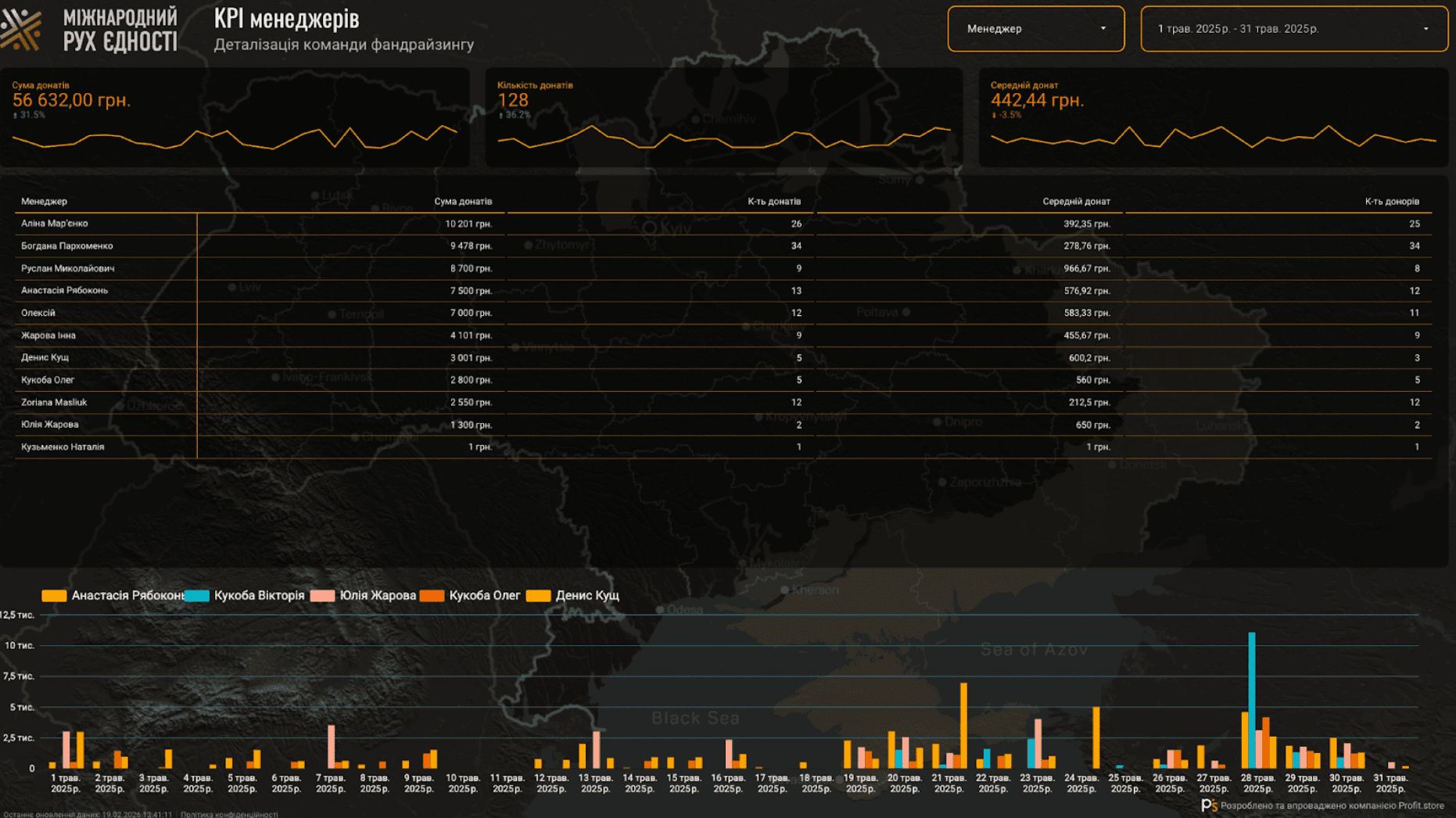 Dashboard with a full breakdown of sales figures by specific fundraiser and departments. It allows control of each conversion stage, the operation of the sales script, the load on the manager, and the efficiency of telephone conversations.
Stage 3. Creation of a single database and donor identification
In charity, there is a problem of “dispersed data”. The same patron can donate today through a personal link to a fundraiser, tomorrow by donating on the website. Previously, these were three different records. We have implemented an automated profile-gluing system.
Thanks to unique identifiers (ID of the website visitor, phone number, and email), the system combines all user actions into one profile. This gave us the opportunity to calculate the real LTV — the total value of the donor over the entire period of cooperation. Understanding LTV has fundamentally changed marketing: now the foundation knows how much it can afford to spend on attracting a new donor, knowing that they will stay with the foundation for years.
Stage 4. End-to-end analytics and custom tracking
End-to-end analytics is the holy grail of marketing. Our goal was to connect every cent spent on advertising with every donation received. We abandoned the standard Google Analytics 4 settings because they didn't provide the necessary depth of data for the specifics of the foundation.
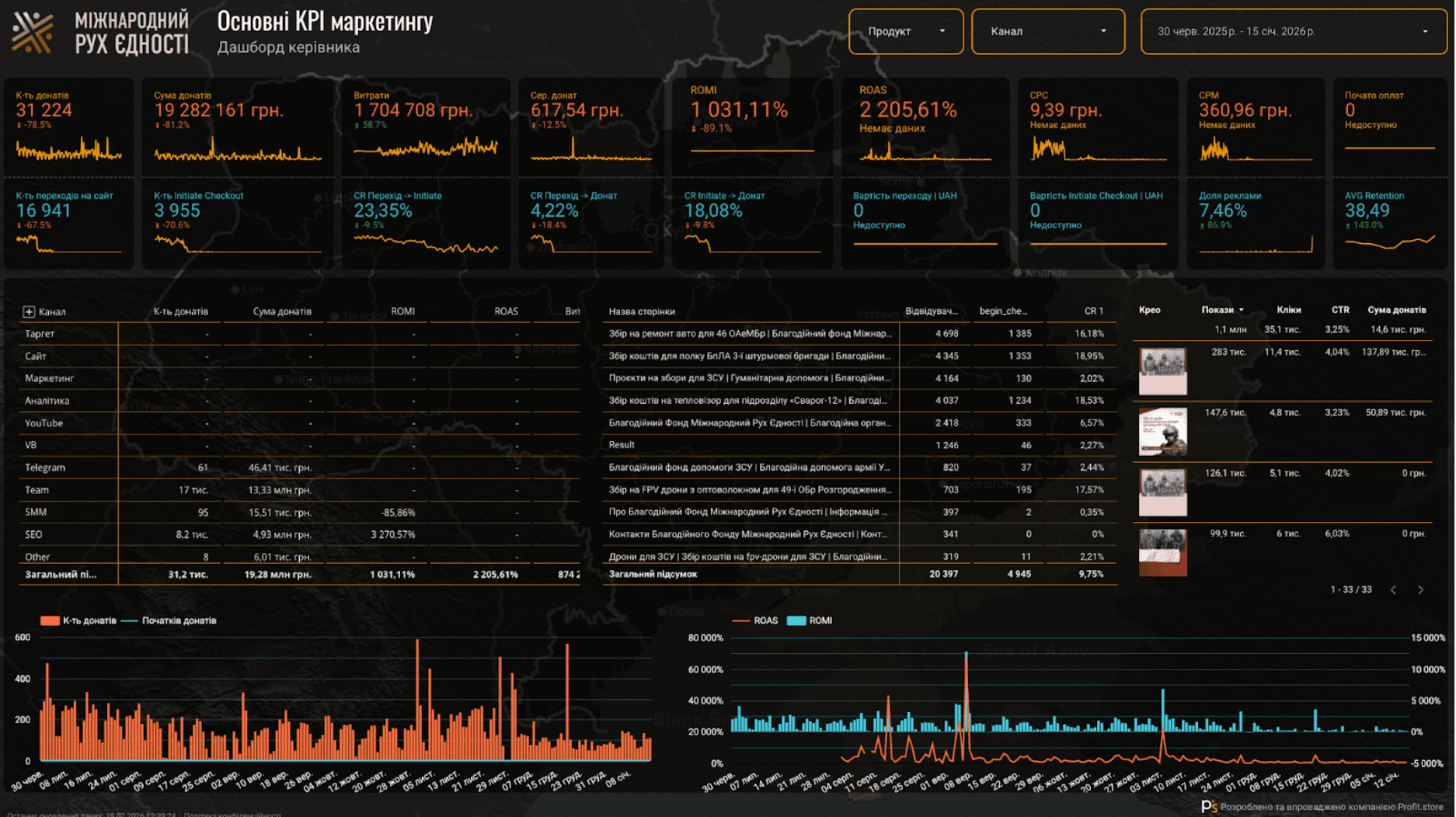 The dashboard is designed to make management decisions based on current data with regular updates. The interactive report has indicators of traffic channel efficiency. It also allows you to perform analysis for the selected period and shows the percentage of plan implementation for each key indicator.
We developed and installed a custom event tracker that “accompanies” the user at every stage. It records not only the fact of visiting the website, but also all 5 UTM tags of the advertising source and Cookie parameters. This data is transmitted to the CRM along with the completed form or transaction. As a result, we created a dashboard system in Looker Studio, where management sees:
- The cost of attracting donations.
- The effectiveness of marketing activities from campaign to ad.
- The effectiveness of organic channels according to the structure of UTM tags.
- ROAS/ROMI of each marketing channel.
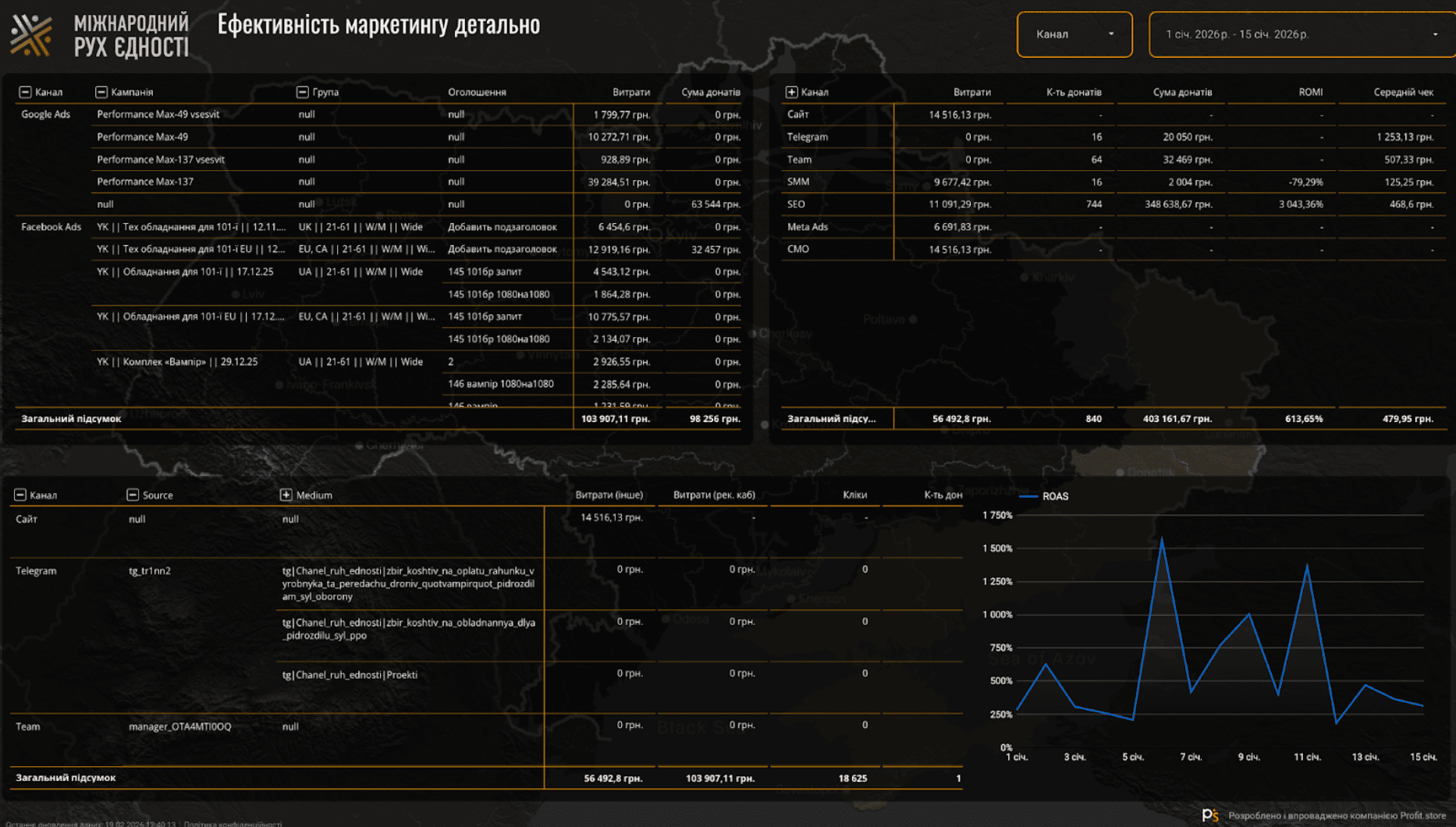 A dashboard that no marketer can live without. It provides maximum detail on each traffic channel, from ad impressions to LTV.
Stage 5. Data-driven attribution and omnichannel analytics
The donor journey is rarely linear. A person might see a post on Facebook, then get retargeted on Instagram, find a fund on Google a week later, and finally make a donation after receiving an email. In the standard "Last Click" model, all success would be attributed to the last email. But this is a mistake that leads to false conclusions.
We have implemented a data-driven attribution model, and we track associated conversions, i.e., the contribution of each channel to the decision-making chain. This allowed the foundation to see that certain "expensive" social media advertising campaigns are actually the primary source of the most loyal donors, even if they don't donate the first time.
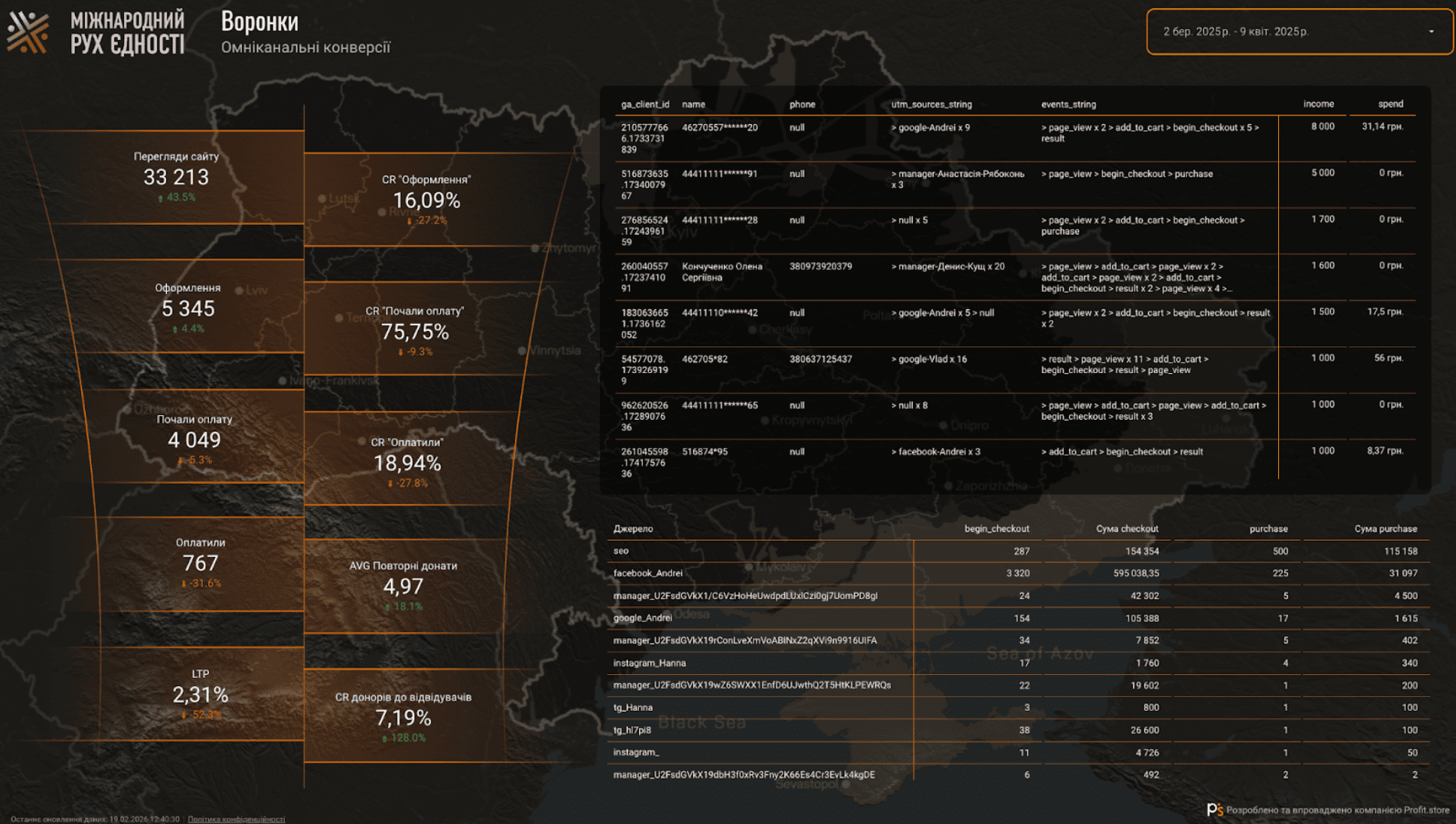 The omnichannel analytics dashboard displays the full conversion funnel and traffic source performance for the selected period. It allows you to see the full donor journey, evaluate ROMI, and make budget reallocation decisions.
Stage 6. RFM segmentation of the donor base
According to the standard RFM segmentation protocol, the distribution was to occur according to three parameters: Recency (how long ago was the last contribution), Frequency (how often the donor helps), and Monetary (what is the total amount of contributions?) But thanks to the active involvement of the client in the development, in the final form, only two parameters were used to form the segments: Frequency and Monetary.
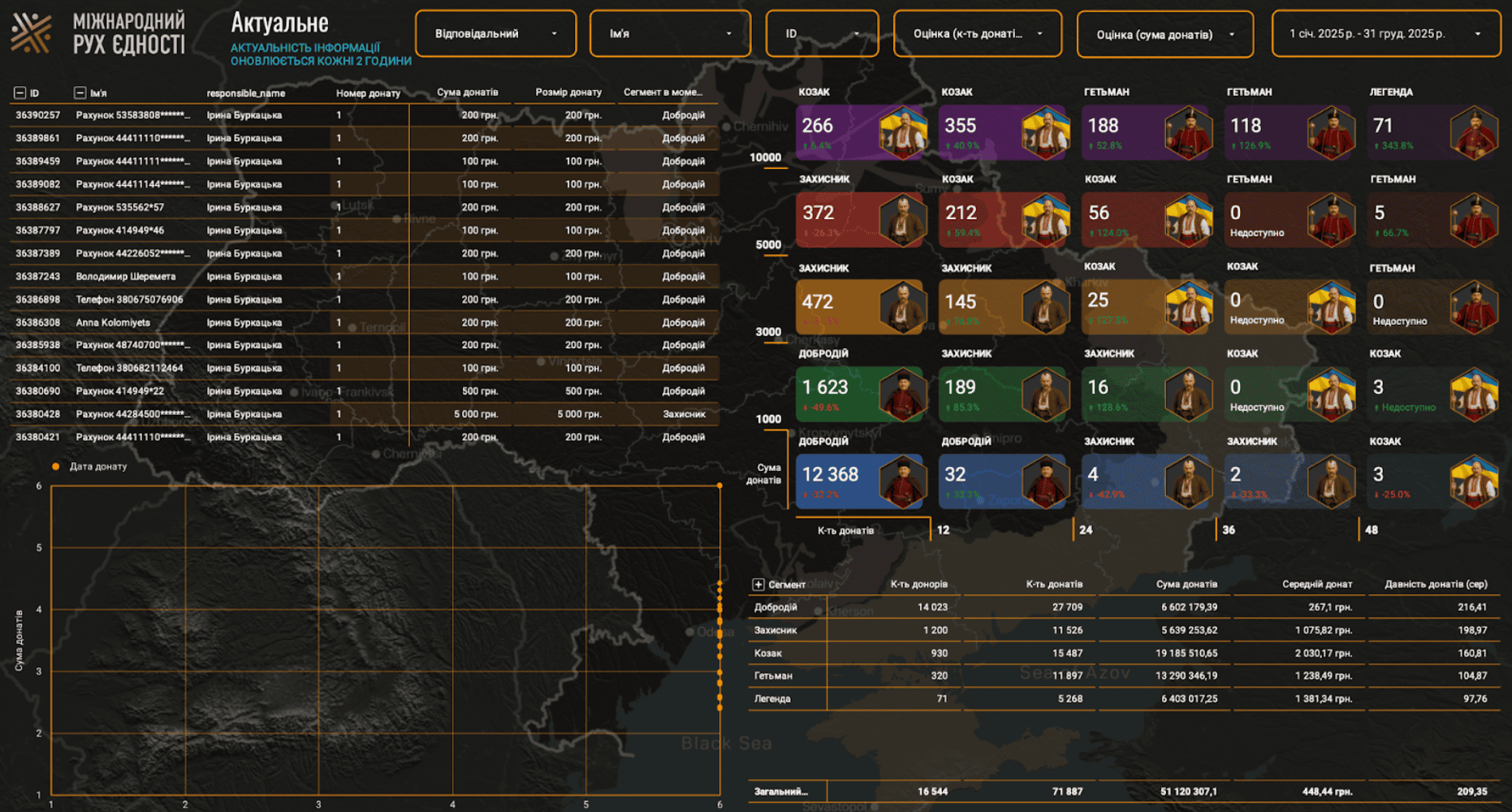 The main dashboard for managing RFM segmentation. It provides summarized information on the distribution of donors by segmentation, donation history for each donor, as well as summarized key indicators for each segment.
The system automatically assigns one of the levels to each donor:
- Kozak: A newcomer who has taken his first step.
- Benefactor: A regular donor who consistently supports the fund with small and medium amounts.
- Defender: A reliable fund partner with a high frequency of contributions.
- Hetman: A VIP donor, a patron who makes large one-time contributions.
- Legend: Top donors whose support is strategic for the foundation.
This segmentation allows you to avoid "spamming" with the same emails and build communication that corresponds to the person's status and contribution.
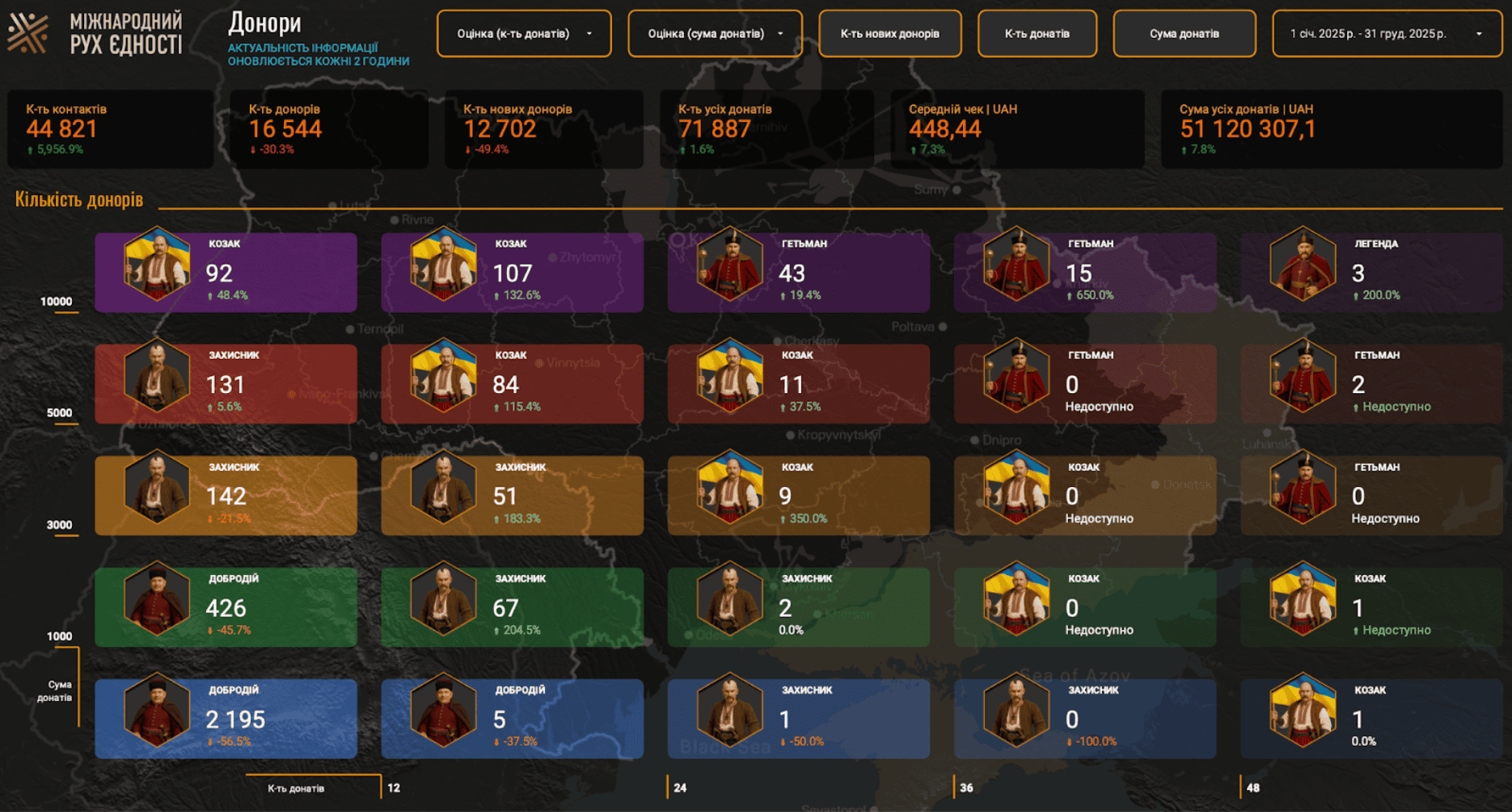
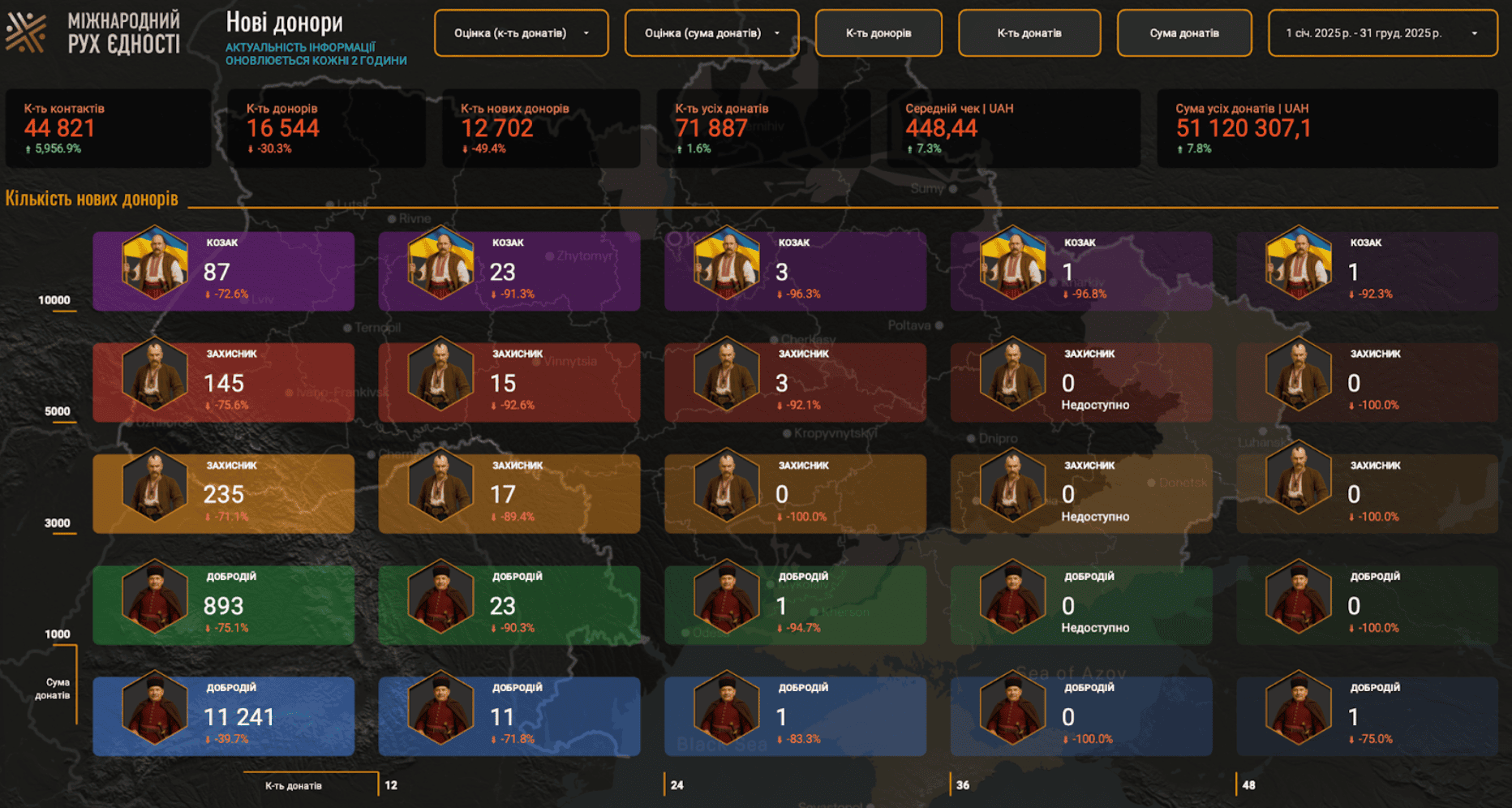
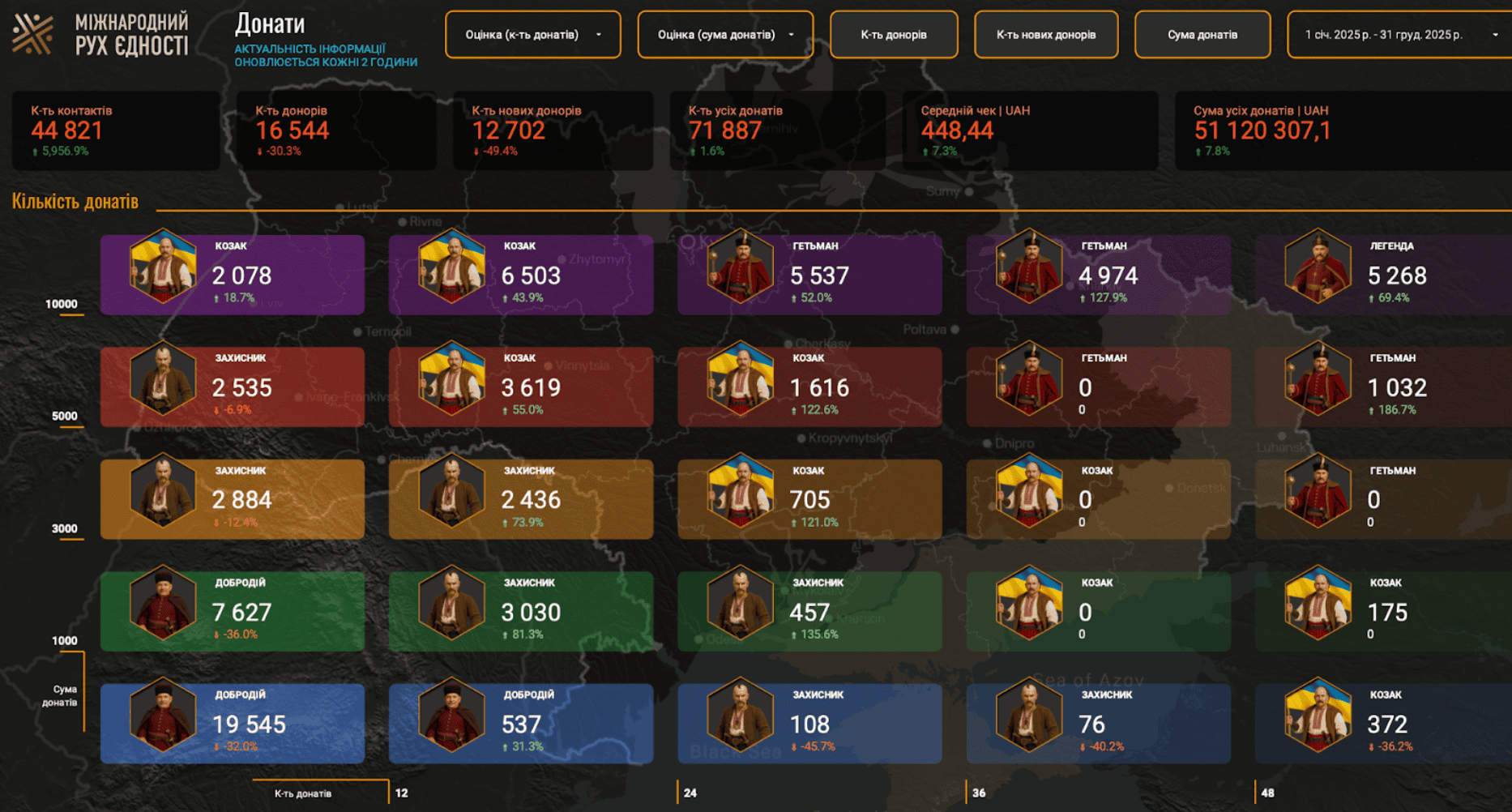
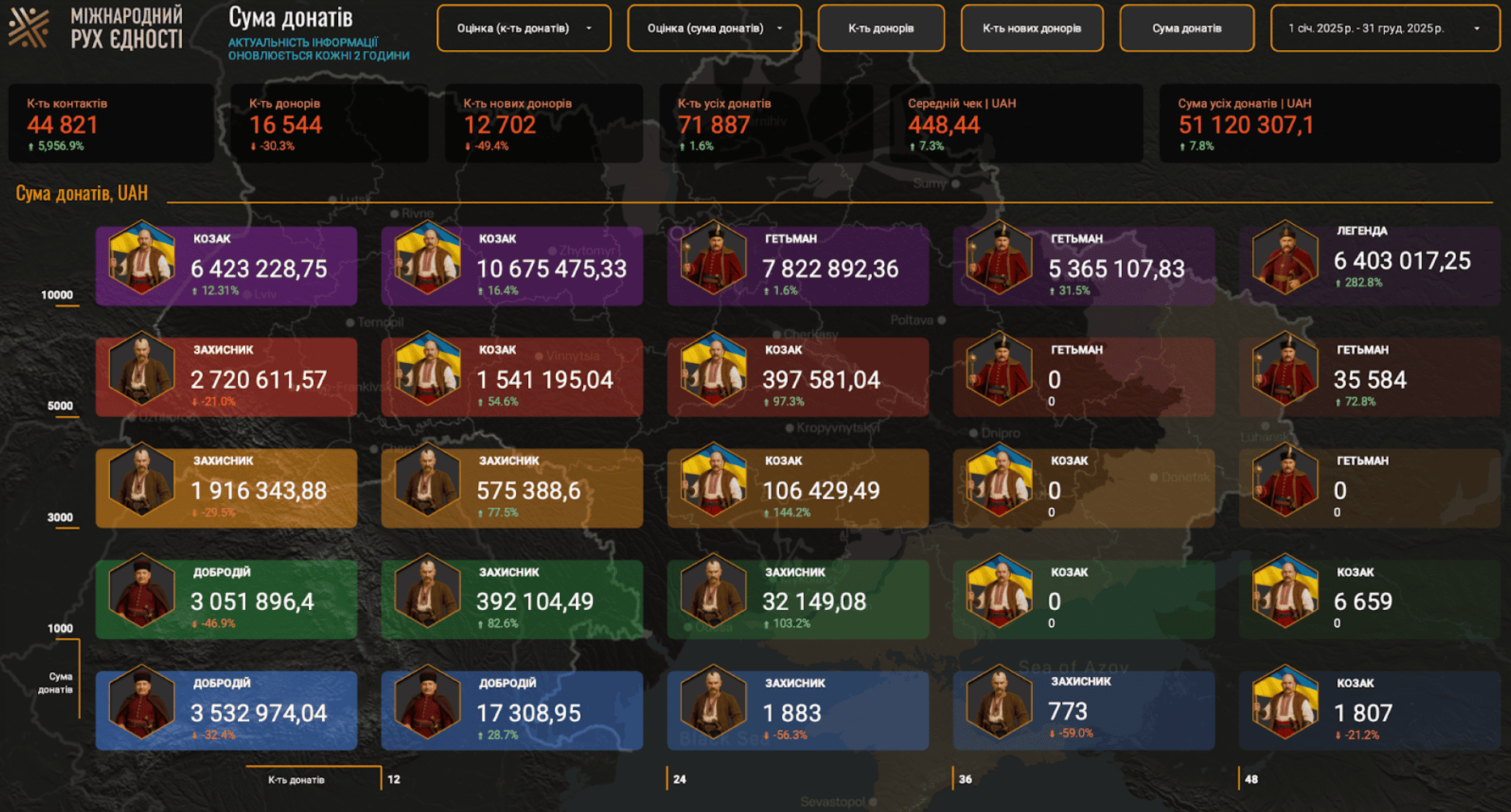 All 4 dashboards show the distribution according to the segmentation matrix. At the top, there are key indicators grouped to form the overall picture. The matrix itself contains information about donors (number of donors, number of new donors, number of donations, amount of donations), which helps answer questions such as “Which segment has the largest audience?" and “Which segment made the largest contributions?” Using the buttons in the top panel, you can quickly switch between views.
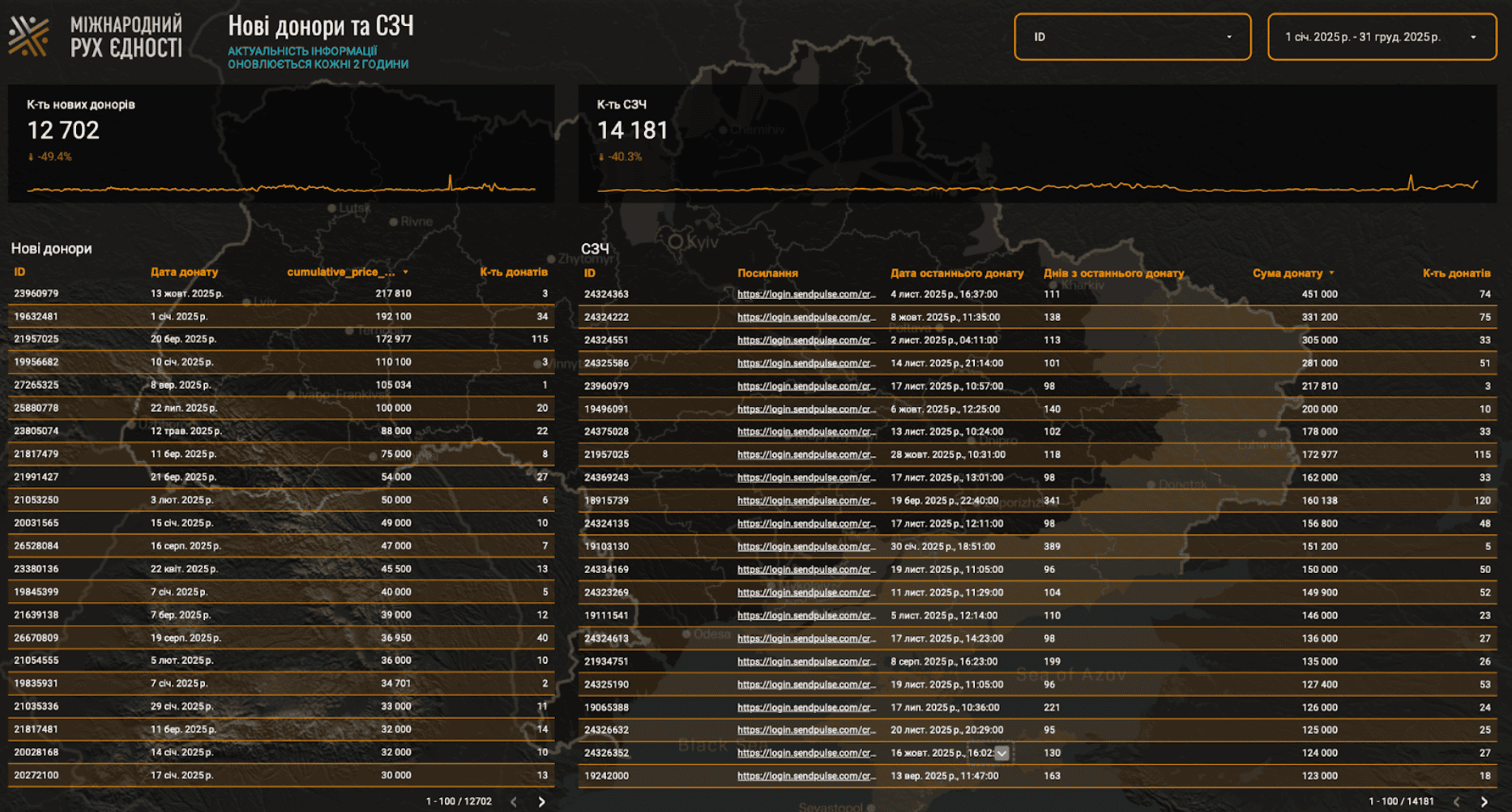 The “New Donors” dashboard provides detailed information on each new and long-inactive donor. It allows a fundraiser to get all the information they need to engage with a specific donor based on their activity and link to their CRM system to contact them.
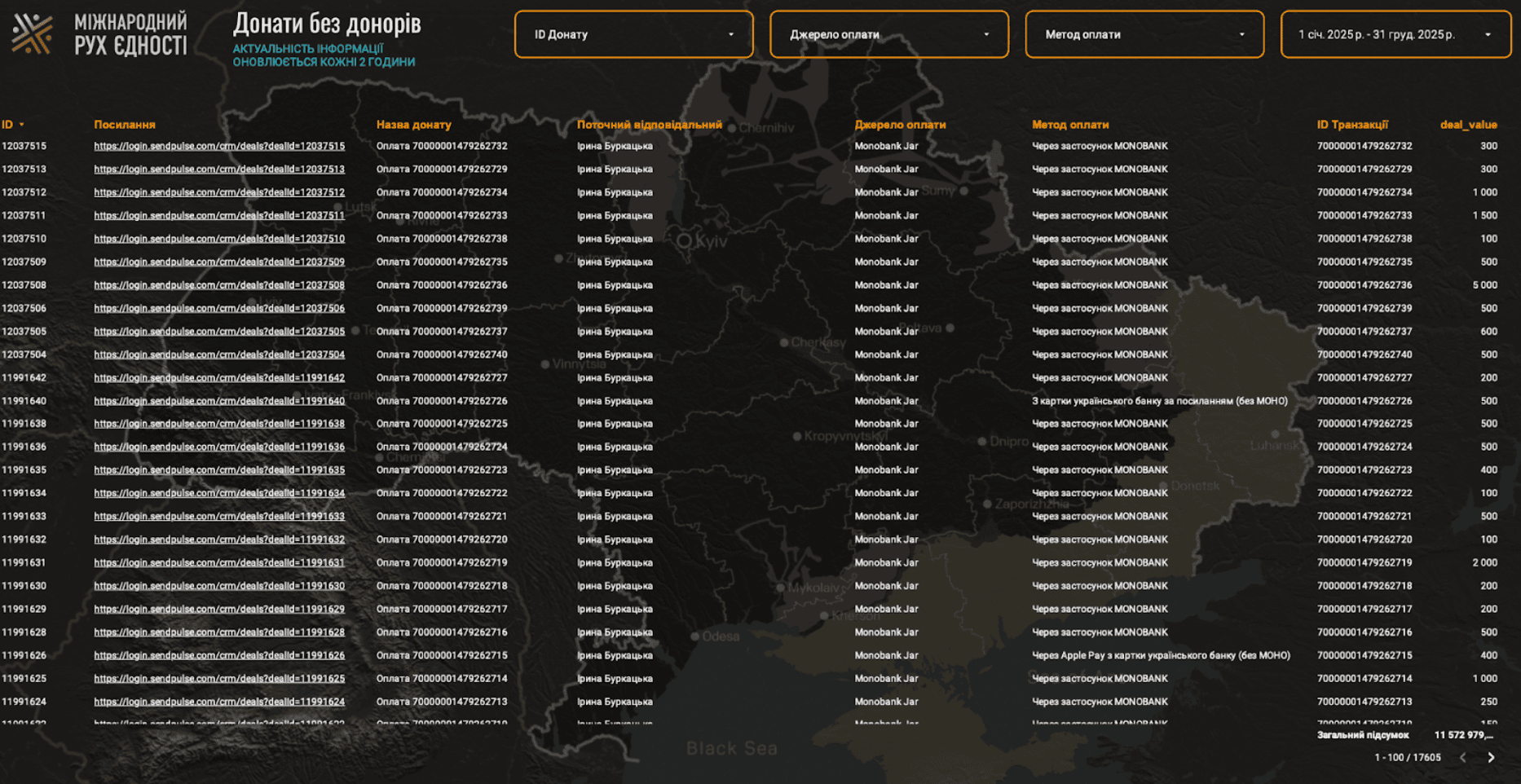 The “Donations without donors” dashboard displays a list of donations that, for some reason, do not have an associated donor (usually due to technical limitations of payment systems). It contains key information about each such donation, as well as a link to the donation card in the CRM system, where more detailed information is provided.
Stage 7. Creating automated personalized marketing funnels
Using RFM statuses, we set up automatic communication funnels in SendPulse chatbots. Now the system works 24/7:
- Registration. The donor provides the system with their contact information (name, phone, email).
- Getting involved in the action. Depending on their interest, the donor is invited to support the Armed Forces of Ukraine with a donation via a chatbot.
- Welcome series. A new donor receives the history of the fund, reports, and a thank-you note, which encourages them to make a second contribution.
- Reactivation of the “sleepers”. If the donor does not respond to the message, they receive regular reminders. If there has been no response for more than 60 days, the system automatically sends a message to the fundraiser to contact the donor directly.
- VIP escort. Special notifications for fundraisers have been set up for “Hetmans” and “Legends” to ensure the highest level of service and personal gratitude.
Stage 8. CAPI and server-side conversions
Given the privacy restrictions in modern browsers (primarily blocking cookies), the regular Facebook Pixel loses some data. To ensure that Meta and Google advertising algorithms work at full capacity, we have configured the Conversions API.
Data on successful donations is transmitted directly from our server to advertising offices. This gives advertising algorithms a clear signal: “This person donated, find us more of them.” This has significantly increased targeting accuracy and reduced the cost of attracting a new donor.
Stage 9. AI Insider
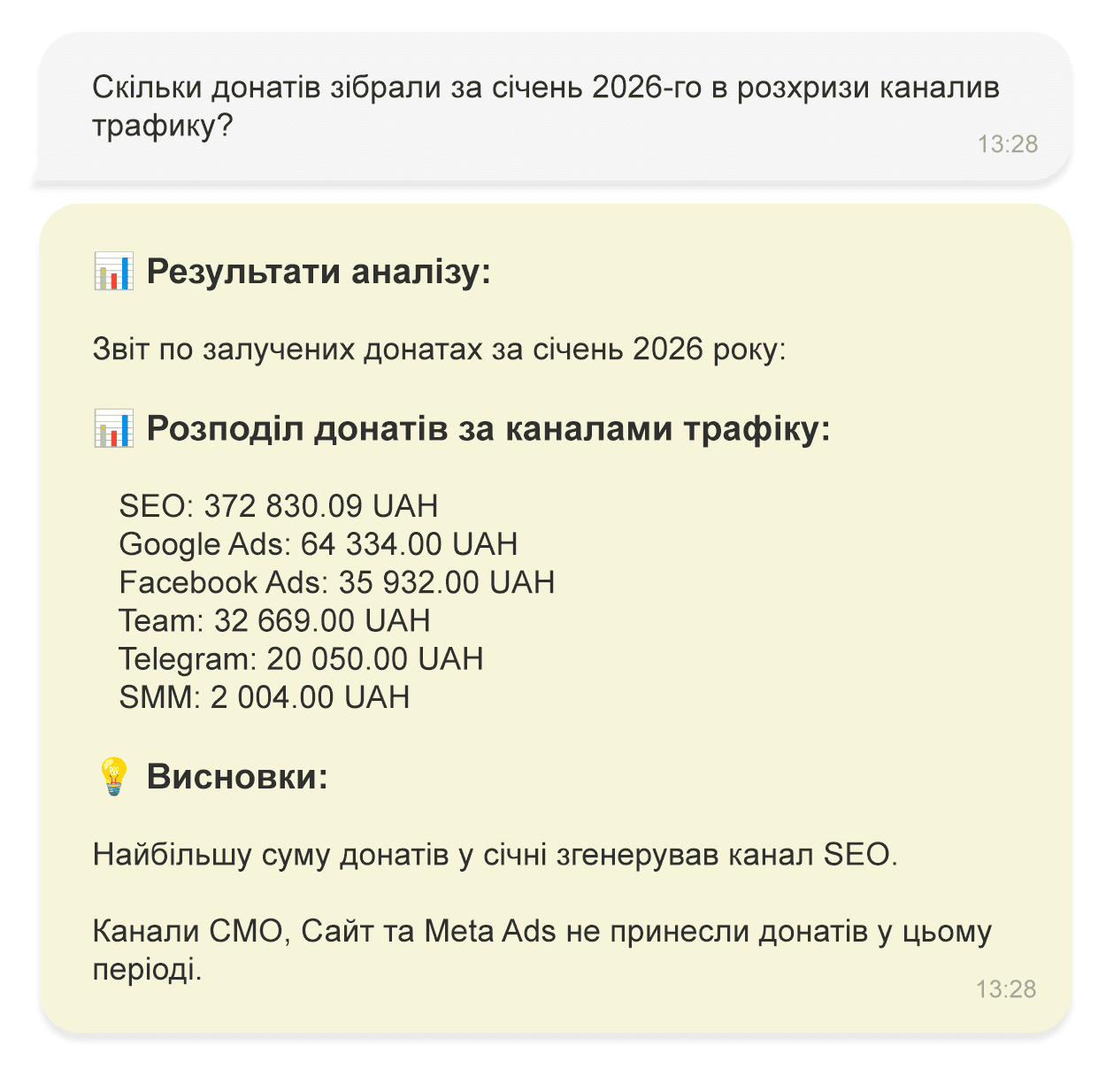
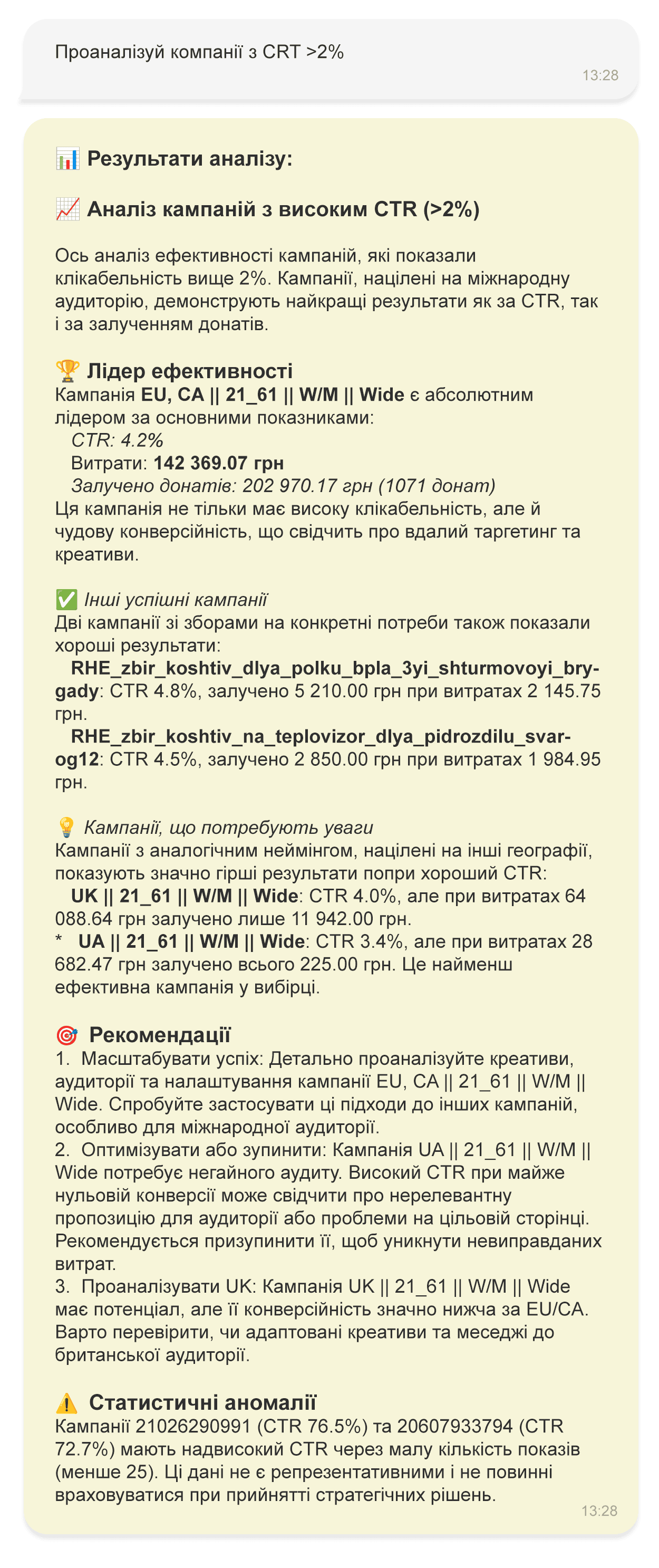
We went further and integrated our own development based on large language models into the system — AI Insider. This is an AI agent that “lives” inside an analytical system. Its task is to be a digital analyst for the fund’s management. Instead of studying tables, the manager can ask a query in natural language:
- "What is the forecast for fees by the end of 2025 based on current dynamics?"
- "Compare the performance of Instagram ads last month and this month."
- "Write tips on how to increase engagement with the Hetman segment based on the latest trends."
The biggest challenge was to train the AI to work with financial data without errors. We developed a system of restrictions that ensures that the AI agent operates only with real facts from the CRM, providing accurate insights for tactical and strategic planning.
Conclusions
The project results exceeded expectations. The International Unity Movement Foundation has transformed into a technological organization where every action is measured and optimized.
Main achievements:
- Effective management. Now the analytical system is an effective tool based on accurate data for scaling profitable activities and getting rid of ineffective ones.
- Time saving. Automation of data collection and communications has freed up hundreds of hours of management work.
- LTV growth. Thanks to RFM segmentation and personalization, donors began to return more often, and their contributions became larger.
- Scalability. Now the fund is ready for any volume of traffic and fees, with a solid digital foundation.
We believe that this approach is the only way forward for modern philanthropy. It is a transition from emotional marketing to data-driven marketing, with respect for each donor.
SHARE

OTHER ARTICLES BY THIS AUTHOR
Get the most exciting news first!
Expert articles, interviews with entrepreneurs and CEOs, research, analytics, and service reviews: be up to date with business and technology news and trends. Subscribe to the newsletter!
By clicking “Subscribe” you agree to Privacy Policy and consent using your contact data for newsletter purposes
OR FOLLOW ON: